| Backstaff Instruments |
| 16 Stonybrook Road |
| Marblehead, MA 01945 |
| Phone: (781) 639-1694 |
| Email For More Information
|
|
The Chip Log |
| These instruments were made for the Salem "Friendship"
- a newly built replica of a 1790's merchant vessel. |
 |
|
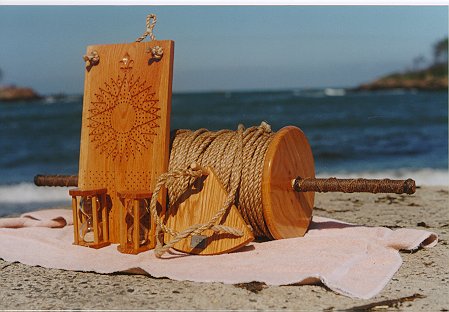
Chip Log, Traverse Board, 28
second Sand Glass.
|
| This photo clearly shows the components
of the chip log spool assembly. |
 |
|
End plates, spindle, and end plate spacers.
|
| Completed spool assembly, and roughed out sandglass frame. |
 |
These instruments were built closer to the workaday
style. In the top photo you see a Chip Log, Traverse Board, a 14 and a 28 second
sandglass.
The Chip Log is nothing more than a large reel with
over 700 feet of line wound up on the spool. The triangular piece
of wood you see on the front, right, is the "chip". This was thrown
over the taffrail of the vessel into the sea. Because it created a
great deal of drag, it stayed where it fell in the water and the
boat sailed away from it.
The rate at which the line ran off the
reel is the speed of the vessel. Knots were spaced along the line at
intervals of 43 feet, 7 inches. This is the distance the vessel would
sail, in 28 seconds, if it were traveling at 1 nautical mile per hour.
If two knots ran off the reel in 28 seconds, you were making two
nautical miles an hour...or two "knots". This is the origin of the
term "knots" which is still in use today. The time period of 28 seconds was
measured out by the 28 second sand glass you see in the photo. If the
vessel was moving exceptionally fast, and there wasn't enough line on the
reel to measure the speed, you would use the 14 second glass as your time
interval and multiply the number of knots you counted by two, to get your
actual speed.
The reel was held by two sailors - one at each handle.
The Sailing Master would toss the chip and count the knots. Another sailor
held the sandglass; turning it upon the order of the Sailing Master and
singing out when all the sand had run out.
A secondary use of the chip log
is to measure the leeway you are making: *so long as* the line is paying
out freely, the angle of leeway will be indicated by the angle between the
log line and the centerline of the ship.
When the knots were properly
spaced on the log line and the time intervals carefully run, this was an
extremely accurate method of finding your speed. In 1997, HMS Bounty use
a chip log I made for her when her GPS was not functioning. She navigated
from Nova Scotia to Boston using the chip log and made an excellent landfall.
If you've ever watched the film made by Irving Johnson as
he sailed Cape Horn, you can see a chip log in action as late as 1929.
Call anytime, Email, or use our
Print-Out Information Request Form to contact us.