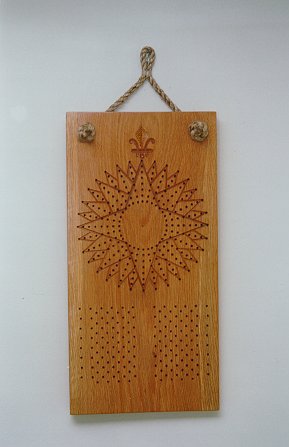
| The Traverse Board was used to record course and
speed over a four hour watch. This example was made from oak. The points of the compass rose and the fleur d'lis were hand carved. |
 |
|
| |
< Backstaff Instruments Email For More Information
| The Traverse Board was used to record course and
speed over a four hour watch. This example was made from oak. The points of the compass rose and the fleur d'lis were hand carved. |
|
|
| |
Call anytime, Email, or use our
Each 4 hour watch was broken up into 8, 30 minute
segments. At the start of a new watch, the log was hove. The measured speed
was indicated in knots and eigths of a knot by placing pegs in the first
two rows of holes at the bottom of the traverse board. The first row
denoted knots; the second eigths of a knot. There are eight sets of two
rows of holes at the bottom of the Traverse Board: one set per 30 minute
"glass" of the watch.
The heading was obtained from the compass
and a peg was placed in the appropriate hole in the inner ring of the
compass rose at the top. There are eight concentric rings of holes: one
ring for each 30 minute "glass" of the watch.
Once the four hour
watch was up, the traverse board was taken below to the chart. The courses
and speeds recorded thereupon were used as the basis of the Dead Reckoning
plot. In Cabot's time, you were done, with the exception of a latitude
reading taken with, say the cross staff. In Napoleonic times, sextant or
quadrant readings were taken and your latitude reckoned (if you could see the
sun or North Star). The Chronometer gave you your longitude. But all was
checked against the DR plot.
Print-Out Information Request Form to contact us.
[Home |
Cross Staff |
Back Staff |
Chip Log |
Altitude Rings |
Sandglasses |
Quadrants |
Hadley Octants |
Nocturnals |
Traverse Board
|
Set for USS Constitution |
]